Cambodia
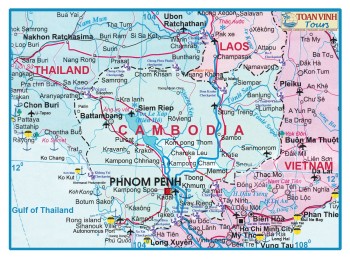 Cambodia covers 181,035 sq km, or a little over half the size of Vietnam. The country's maximum extent is about 580 km (east-west) and 40 km (north-south). It is bounded on the west by Thailand, on the north by Thailand and Laos, on the east by Vietnam and to the south by the Gulf of Thailand.
 Cambodia's two dominant topographical features are the Mekong River, which is almost 5km wide in places, and the Tonlé Sap lake. The Mekong, which rises in Tibet, flows about 486 km through Cambodia before continuing, via southern Vietnam, to The South China Sea. At Phnom Penh, it splits into the Upper River (called simply the Mekong or, in Vietnamese the Tien Giang). The rich sediment deposited during the Mekong's annual wet-season flooding has made for very fertile agricultural land. Most of Cambodia's streams and rivers flow into the Mekong -Tonlé Sap basin.
 The Tonlé Sap lake is linked to the Mekong at Phnom Penh by a 100km - long channel known as the Tonlé Sap river. From mid-May to early October (the rainy season) the level of the Mekong rises, backing up the Tonlé Sap river and causing it to flow north-west into the Tonlé Sap lake. During this period, the Tonlé Sap lake swells from 3000sqkm to over 7500sq km; its maximum depth increases from about 2.2m to more than 10m. As the water level of the Mekong falls during the dry season, the Tonlé Sap river reserves its flow, draining the water of the lake back into the Mekong. This extraordinaire process make the Tonlé Sap lake one of the world's richest sources of freshwater fish.
 In the centre of Cambodia, around the Tonlé Sap lake and the upper Mekong Delta, is a low-lying alluvial plain where the vast majority of Cambodians live.
In the south-west, much of the area between the Gulf of Thailand and the Tonlé Sap lake is covered by a highland region formed by two distinct upland blocks: the Chuor Phnom Kravanh in south-western Battambang Province and Pursat Province, and the Chuor Phnom Damrei.
Along Cambodia's northern border with Thailand, the plains abut an east-west oriented sandstone escarpment, more than 300km long and 180 to 550 in hihgt, that marks the southern limit of the Chuor Phnom Dangkrek.
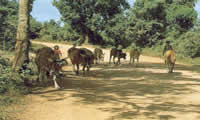 Cambodia can be neatly divided into two geomorphological regions: the central plains of the Mekong-Tonlé Sap basin which formed from an ancient marine gulf and later filled with alluvium and colluvium from the Mekong river; and the basin periphery of mountain ranges which include a variety of mineral and soil types.
Time : Time in Cambodia is 7 hours ahead of Greenwich Mean Time (GMT*7)
Climate: The climate of Cambodia is governed two monsoons, which set the rhythm of rural life. The cool, dry, north-eastern monsoon, which carries little rain, blows from about November to February. From May to October, the south-western monsoon brings strong winds, high humidity and heavy rains. Even during the wet season it rarely rains in the morning: most precipitation comes in the afternoon, and even then only sporadically.
Maximum daily temperatures range from more than 40°C in April, the hottest month, to the high 20s during January, the coolest month. Daily minimum temperatures are usually no more than 10°C below the maximums.
Annual rainfall varies considerably from area to area. Whereas the seaward slopes of the south-west highlands receive more than 5000mm of rain per annum, the central lowlands average only about 1400mm. Between 70%-80% of the annual rainfall is brought by the south-western monsoon.
Flora:
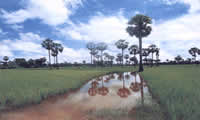
The central lowland consists of rice paddies, fields of dry crops such as corn and tobacco, tracts of reeds and tall grass, and thinly wooded areas. The transitional plains are mostly covered with savanna grasses which grow to a height of 1.5m. In the south-west, virgin rainforests grow to heights of 50m or more on the rainy seaward. Mearby higher elevation support pine forests. Vegetation in the coastal strip includes both evergreen and mangrove forests. The symbol of Cambodia is the sugar palm tree, which is used in the construction and in the production of medicine, wine and vinegar.
Fauna:
Cambodia's larger wild animals include bears, elephants, rhinoceroses, leopards, tigers and oxen. The llion, although often incorporated into Angkorian heraldic devices, has never been seen here. Among the country's more common birds are cormorants, cranes, egrets, grouse, herons, pelicans, pheasants and wild ducks.
Language:
Khmer: official language, part of the Mon Khmer family.
English, French : second languages
HISTORY
Early beginning:
The Kingdom was named Kambuja, an Indian, from around the first century AD.
Indianisation & Funan:
The early Indianisation of Cambodia probably occurred via trading settlements that sprang up from the first century AD on the coastline of what is now southern Vietnam. Such settlements served as ports of call for boats following the trading route from the Bay of Bengal to the southern provinces of China. The largest of these was known as Funan, close to contemporary Oc-Eo in Lien Giang Province of southern Vietnam.
Chenla period:
From the 6th century Funan's importance as a port declined and Cambodia's population gradually concentrated along the Mekong and Tonlé Sap rivers. The move may be related to the development of wet-rice agriculture. This period is generally referred to as the Chenla. Again, as is the case with Chinese term and there is little to support the idea that the Chenla was a unified kingdom that held sway over all Cambodia.
Discover the many faces of Cambodia with us
The discovery of authentic
Cambodia, a big and powerful Empire in the past, is now a little charming Kingdom in Indochina with a surface area of 181,035 km square. It is bordered by the Laos PDR and Thailand to the North, Vietnam to the East and South, Thailand and the Gulf of Siam to the West.
Cambodia has reopened its door to show great beauty, unique culture whose warm and charm will inspire you. As Cambodia races to catch up with its neighbour in South-East Asia after many years of war it has become the land of beauty that has more than 10 million sympathetic, warmhearted and very friendly inhabitants. As Cambodia is an agricultural country, around 85% of people are peasants.
 In fact Cambodia was populated since 5,000 BC, but the early state described in Chinese chronicles as Founan, an indianised state of the 1st century. Between the 9th and the 14th century, the mighty Khmer Empire ruled over the entire Indochina, from which humanity inherits a marvellous patrimony, the Angkor complex. After the abundance of Angkor, Cambodia fell into turmoil of continuous civil wars. France ruled the country for almost a century and after a short "Golden Age" of the Sangkum Reastr Niyum, the Pol Pot regime forced the country into loneliness and genocide.
The Kingdom of Cambodia is now divided into 19 provinces and 2 cities: one is the Capital of Phnom Penh, another is Sihanouk Ville, the seaport of Cambodia. You will enjoy on the land that is full of resources such as gold, gem, rubber, fish...with the people who live with an absolute different lifestyle, which turns your holiday into one of the most rewarding experience you ever had. Theravada or Hinnayana Buddhism is the formal religion of Cambodia, 90% of the inhabitants are Buddhist, but the liberty of faiths not prohibited. Travel into a splendid ancient Khmer city that bring you to a variety of historic sites that reflect classic Khmer culture and civilization of several centuries old.
CULTURE
Arts : The Khmer Rouge's assault on the past and on artists and intellectuals was a terrible blow to Cambodian culture. The Khmer Rouge not only did away with living bearers of Khmer culture, it also destroyed cultural artefacts, statues, musical instrument, books and anything that served as a reminder of a past it wished to efface. Despite this, Cambodia today is witnessing a resurgence of traditional arts and a limited amount of experimentation in modern arts.
Dance : More than any of the other traditional arts, Cambodia's royal ballet is a tangible kink with the glory of Angkor. Early in his reign, King Sihanouk released the traditional harem of royal apsara (heavenly nymphs) that went with the crown. Nevertheless, prior to the Pol Pot regime, classical ballet was still taught at the palace. Its traditions stretched long into the past; when the art of the apsara redounded tp the glory of the divine king. Cambodian court dance is related to the dance of Thailand, Java and India. They all share the same cultural sources, and many of the dances from the Hindu Ramayana. Another interesting dance tradition is lkhaon khaol, Cambodia's masked theatre. Traditionally all the roles are played by men, like kabuki in Japan and some of the regional opera styles in China.
Music : The bas-reliefs on some of the monuments in the Angkor region depict musicians apsara holding instruments. The instruments that are depicted are similar to the traditional Khmer instruments of today, which suggests that Cambodia has a long musical tradition all its own. Traditionally the music of Cambodia was an accompaniment to a ritual or performance that had religious significance. Musicologists have identified six types of musical ensemble, each used in different settings. The most traditional of these is the areak ka.
Architecture : Khmer architecture reached its period of greatest magnificence during the Angkorian era (the 9th to the 14th centuries). Some of the finest examples of architecture from this period are Angkor Wat and the structures of Angkor Thom. See the Temples of Angkor special section for more information on the architectural styles of the Angkor are.
Sculpture : Even in the pre-Angkor era, in the periods generally referred to as Funan and Chenla, the people of Cambodia were producing masterfully sensuous sculpture that was no simple copy of the Indian forms it was modelled on. Some scholars maintain that the Cambodian forms are unrivalled in India itself. The earliest surviving Cambodian sculpture dates from the 6th century. Most of it depicts Vishnu with four or eight arms. Generally Vishnu has acquired Indo-chinese facial characteristics and is more muscular than similar Indian sculpture, in which divinities tend towards rounded flabbiness. A large eight-armed Vishnu from this period is displayed at the National Museum in Phnom Penh
RELIGION AND COMMON COURTESIES
Religion :
Hinduism : Hinduism flourished alongside Buddhism from the first century until the 14th century. Hinduism was represented by the worship of Harihara.
Buddhism : The majority of the people of Cambodia are followers of Theravada, or Hinayana, Buddhism. Buddhism was introduced to Cambodia between the 13th and the 14th centuries and was the state religion until 1975. between 1975 and 1979 the vast majority of Cambodia's Buddhist monks were murdered by the Khmer Rouge and virtually all of the country's more than 3000 wats were damaged or destroyed. In the late 1980s Buddhism was again made the state religion. At that time, Cambodia had about 6000 monks, who by law had to be at least 60 years old. The age requirement have been relaxed and young monks are once again a normal sight.
Islam : Cambodia's Muslims are descendants of Cham who mifrated from what is now central Vietnam after the final defeat of the Kingdom of Champa by the Vietnamese in 1471. Whereas their compatriots who remained in Vietnam were only partly Islamicised, the Cambodian Chams adopted a fairly orthodox version of Sunni Islam and maintained links with other Muslim communities in the region.
Vietnamese religions : during the 1920s quite a few ordinary ambodians became interested in Caodaism, a colourful syncretic religion founded in Vietnam.
Common courtesies :
Like the Thais, who have their wai, the Cambodians traditionally greet each other with the sompiah , which involves pressing the hands together in prayer and bowing. In general the higher the hands and the lower the bow the more respect is shown. In recent decades this custom has been partially replaced by the western practice of shaking hands. But, although men tend to share hands with each other, women usually use the traditional greeting with both men and women. It is considered acceptable for foreigners to share hands with Cambodians of both sexes.
PHNOM PENH & ITS SURROUNDING
An Admirable Small Historic City
Phnom Penh, Capital of the Kingdom of Cambodia that was founded since 1434, it is a small city with a population of approximately one million people. Explore this bustling city that full of commercial and entertainment. There are varieties of hotels and restaurants to choose from, so you can just lay back and relax with the excellent accommodation, superb restaurants with top chief in Khmer cuisine, Asian and European. It's all waiting for you !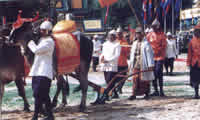
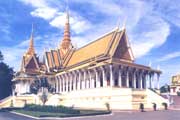
The Royal Palace is home to his Majesty the King and Her Majesty the Queen. Within the compound is the Silver Pagoda, its floor elegantly covered by 5,000 silver tiles. On display are also hundreds of gifts presented to the Royal family over the years, including a solid gold Buddha weighing 90 kg and encrusted with 9,584 diamonds. The compound also houses Wat Phnom Mondap, which contains Buddha's footprint.
Wat Phnom is the name of a pagoda. It was built by lady Penh in 1372 on a little hill that is located right in the heart of the city. Behind the pagoda, there is a big stupa that is believed to contain the ashes of King Ponhea Yat, the first founder of the Capital Phnom Penh. The Royal Palace stands just opposite the four branches of the Mekong river. It was originally built in 1866, and reconstructed later in 1913, with numerous buildings of remarkable Khmer architecture.
 Silver pagoda, so called because of the 5,329 silver tiles that cover the floor, South of the Throne Hall. It is known by Cambodian as the Emerald Pagoda. It was built in 1892 and reconstructed in 1962. Inside, there are hundreds of royal gifts received by the Royal family over the years put on display. There you also can find a solid golf Buddha encrusted with over 9,500 diamonds and weighing 90 kg.
The National Museum, a great red and elegant building that is stood highly to the North of Royal Palace, it was constructed in 1917, this Museum shows the fascinating of Cambodian arts archaeology.
Phnom Chiso, a prehistoric temple of Angkorian - area situates on a hilltop somewhere about 50 km to the South of the Capital. It was built by Soryavarman with extensive views from the top of the hill.
Oudong, 40 km in the North-West, the former capital in the 16th - 18th century before Phnom Penh.
Choeung Ek, the killing field, this memorial is dedicated to the Cambodian executed and buried during the crucial period between 1975-1979.
Tonle Bati, some 30 km in the South of Phnom Penh where there are two famous temples of Angkorian period.
ANGKOR
Marvelous Cultural Patrimony For The Humanity
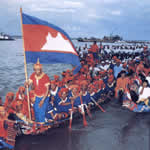 Cambodia is rich of historic sites, especially the remains of the Golden Age of Angkor whose temples are found mainly in Siem Reap, about 314 km North-West of Phnom Penh.
Siem Reap is a bustling tourist attraction due to its proximity to tha Angkor Temple Complex, the world's largest religious monument. This huge compound of palaces and temples was built on the sprawling alluvial plain to the North of the Tonle Sap.Besides the temple complex, the floating village on the Tonle Sap Lake is definitely worth a visit. Siem reap is a thriving tourist destination whose hotels enjoy high occupancy rates. 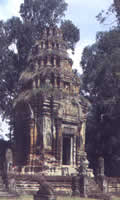
Angkor was the biggest city in South East Asia during the 9th - 12th century, comprising numerous monuments out of comparison. The Angkor temples were built by fine Khmer architecture, naturalistic, complicated and full of symbolism. Hidden in the forest, they are embalmed by the perfume of the Krovan and Rumduol flowers and made lively by the lugubrious song of cicadas. The time spend to see the temples is unlimited.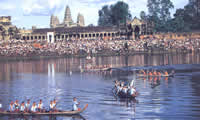
Angkor Wat, a marvellous temple, the most well known all around the world, was built in the beginning of the 12th century. Its magnificent five towers in the form of lotus bud rise majestically, and are used as emblem in Cambodia flag. The architecture and bas-relief of the temple symbolize the wealth, prosperity and engineering of Khmer people, and the zenith of Khmer culture.
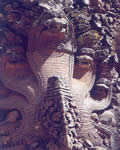 Bayon is just in the center of Angkor Thom, the city erected by jayavarman VII at the end of the 12th century. The main tower and the fifty surrounded others are all ordained by the four mystic and smiling faces of Avalokitecvara, staring at four points of the compass.
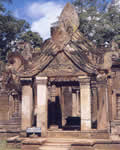
Banteay Srei (Female Citadel), about 30 km north of the Siem reap, was built in the second half of the 10th century, dedicated to Shiva. The beauty of the red sandstone bas-reliefs is very wonderful.
Other multiple impressive temples on the Small Circuit and the Grand Circuit need also to be visited, like the pyramidal sanctuary Takeo dedicated to Shava, Bakheng the heart of the first Angkor, Pre Rub in brick on a pyramidal tiers, Ta Prohm invaded by the forest, preah Khan...
SIHANOUK VILLE
Magnificent beaches
Sihanouk ville is situated about 230 km off the South-West of Phnom Penh. This tropical beach is clean warm with exceptionally clear sea-water and glittering white sand naturally decorated by splendid rock. The tranquil water is perfect for swimming, sunbathing or just relaxing after tiring visits to Angkor. If you want to see natural view and get clean fresh air and extraordinary delicious seafood, Sihanouk ville has it all. He varieties of accommodations and restaurants are available in a reasonable price. It take about 3 hours to journey from Phnom Penh to Sihanouk Ville on a comfortable luxury air-conditioned bus. You will enjoy the wonderful natural view of mountain, forest, valley along the road, which all makes your journey the unforgettable one.
Kompong thom
Kompong Thom is about 170 km away from Phnom Penh. About 3 hours drive along National Road Number 6 we will reach there. Kompong Thom is one of the five provinces, surrounding Tonle Sap Lake. About 35 km from the town you can visit Sambo Prei Kuk group of temples from 7th century in Pre-Angkorian period.
Sen monorom
At about 16,000 sq km, Sen Monorom, the capital of Mondulkiri, is one of Cambodia's largest provinces. Home to some 30,000 people, the villages and tribes are scattered throughout the mountainous region.
The spectacular Sen Monorom Waterfall is easily accessible from the town of Sen Monorom. This province is renowned for its breath-taking scenery.
Krong kor kong
Located west of Phnom Penh, part of the Koh Kong province forms the Thailand-Cambodia border. This proximity allows visitors to sample both Thai and Khmer culture and cuisine.
Koh Kong forms Cambodia's most extensive coastline and is a delight for those who enjoy fishing, snorkelling or simply exploring the sweeping bays, tropical forests and surrounding tropical islands.
A quiet boat trip on the waters will take the visitor to the mangrove swamps in the vicinity, reputed to be some of the world's most impressive.
Battambang
Situated about 292 km from Phnom Penh, Battambang is the second largest city in Cambodia. Quiet and serene, it was founded on the banks of the Stung Sangker river in the 11th century.
It is home to interesting historical sites like Wat Ek, a temple built by Suryavarman I in the 11th century, Wat Toul Baset which dates back to the 7th century and Wat Po Veal Museum which displays Khmer art.
Stung treng
Stung Treng is about 300 km from Phnom Penh and 40 km south of the Laos border. It lies on the eastern bank of the Mekong river. The population is a mix of Khmer, Laos and Thai people who make a living through fishing, trading and other related activities.
Stung Treng will mesmerise the adventurous visitors and photography enthusiasts with its many rapids, waterfalls and different bird species.
Banlung
Banlung is the Capital of Nattanakiri province, and approximately 600 km north-east of Phnom Penh. The area is best known for its exciting ecotourism opportunities.
It is home to hill tribes like the Jorais, Kreungs and Tampuans, who live an isolated life carrying on traditions that have endured through time. Wildlife is plentiful, with many varieties of flora and fauna. Tigers, which roam freely in the deep jungles, are a protected specie.
|
Official name : |
Kingdom of Cambodia |
|
|
Area : |
181,035 square kilometres |
|
|
Ethnic groups : |
Kmers - 90% |
|
|
|
Chams (khmer Islam), hilltribes, Chinese, Vietnamese -10% |
|
|
Population : |
11.7 million |
|
|
Religion : |
Theravada Buddhism is the official religion, only about 5% is Islam and Christianity |
|
|
Language : |
Khmer: official language, part of the Mon Khmer family. |
|
|
|
||
|
Time : |
7 hours ahead of GMT |
|
|
Currency : |
Riel: US$1 is around 3,800 Riels (at time of printing). However this rate fluctuates very |
|
|
|
much according to the economic condition in the country and region. Foreign currency |
|
|
|
US dollar, French franc, Thai Bath are possible to pay and may be exchanged at |
|
|
|
bank, hotels and at some markets. Some credit cards can be used, Traveller's |
|
|
|
cheques and bank draft are acceptable. |
|
|
Climate : |
Tropical hot and humid, average temperature is around 27o C. |
|
|
|
Cool season - November to February |
|
|
|
Hot season - March to May |
|
|
|
Rainy season - June to October |
|
|
Water : |
It is advisable to drink only bottled of boiled water. Never drink tap water. |
|
|
Electricity : |
220 volts, 50 cycle alternation currents. |
|
|
Shopping : |
Shops offering gems scarves and other souvenirs are to be found in the big markets, i.e. |
|
|
|
the Central Market, customers should use caution every time you buy gold and gems. |
|
|
Hospital : |
There are some state-owned and private hospitals, where qualified Cambodian and |
|
|
|
Foreign doctors work. |
|
|
Transportation : |
For touring in the city, there are rental cars, cyclo-pousses and motorbikes, taxis. |
|
|
Visa : |
A one-month tourist_information_cambodia.htm visa is available on arrival at Pochentong Airport Phnom Penh and |
|
|
|
Siem Reap Airport for $20 (USD), with validity of their passport and two photos. |
|
|
|
Visa |
Available at Pochentong International Airport |
|
|
Business |
|
|
|
tourist_information_cambodia.htm |
|
|
|
Airport tax |
International departure |